
Zachman Framework for Enterprise Architecture
Zachman Framework consulting — ontological classification of enterprise architectures, complementing TOGAF and ArchiMate for complete architecture description.
Understanding Zachman Framework for Enterprise Architecture
What Is the Zachman Framework
The Zachman Framework is an ontological structure — a two-dimensional classification schema — for organising and describing the artefacts of an enterprise architecture. Created by John Zachman in 1987 and continuously refined, it provides a complete taxonomy of the descriptive representations that are relevant to an enterprise and its information systems.
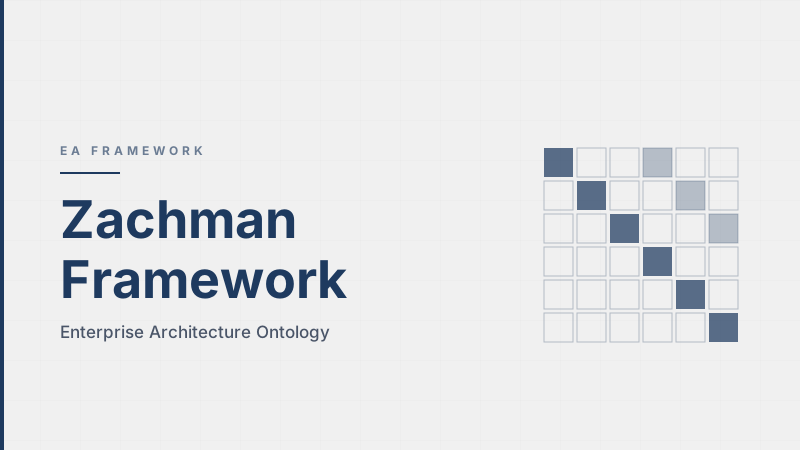
The 6×6 Matrix
The framework is structured as a 6×6 matrix. The six rows represent stakeholder perspectives (Planner, Owner, Designer, Builder, Implementer, and User) from scope to instantiation. The six columns represent architectural aspects (What, How, Where, Who, When, and Why) — the interrogatives that must be answered to fully describe any complex system.
Classification vs. Methodology
The Zachman Framework is deliberately an ontology, not a methodology — it classifies what must be described rather than prescribing how to do EA. This makes it complementary to TOGAF (which provides the process) and ArchiMate (which provides the modelling notation), offering the complete descriptive vocabulary for enterprise architecture.
Where Most Organisations Get Stuck
Incomplete Architecture Descriptions
Unstructured Architecture Artefacts
Stakeholder Perspective Gaps
Fragmented Architecture Views
Missing Architectural Reasoning
Key Requirements
The Zachman Framework defines 36 cells — the intersection of six stakeholder perspectives and six architectural interrogatives — each representing a distinct type of architectural artefact.
Six Stakeholder Perspectives
Planner (scope context), Owner (business model), Designer (system model), Builder (technology model), Implementer (detailed specifications), and User (functioning enterprise) — each requiring distinct architectural representations.
Six Architectural Interrogatives
What (inventory/data), How (process/function), Where (distribution/network), Who (responsibility/people), When (timing/events), and Why (motivation/strategy) — the complete set of questions needed to describe any enterprise.
Primitive vs. Composite Models
The framework distinguishes primitive models (single-cell artefacts, each describing one aspect from one perspective) from composite models (multi-cell views combining aspects for communication purposes).
Stakeholder Concerns
Each cell addresses specific stakeholder concerns — ensuring that architecture descriptions are grounded in the needs and questions of each perspective rather than being technology-centric.
Completeness and Scope
The framework's power lies in identifying gaps — any unanswered cell represents a missing architectural description, revealing where the enterprise is not yet fully understood or documented.
Scope of Engagement
Architecture Inventory Assessment
Evaluate existing architecture artefacts against the Zachman matrix to identify coverage gaps and unrepresented perspectives.
Zachman Matrix Population
Classify existing and planned artefacts into the 36-cell matrix, establishing a structured architecture inventory.
Perspective Alignment
Ensure artefacts are produced for the appropriate stakeholder perspectives — from planner scope to implementer specifications.
Integration with TOGAF & ArchiMate
Map Zachman cells to TOGAF ADM phases and ArchiMate viewpoints to create a coherent, tri-framework architecture practice.
Stakeholder Engagement
Use the Zachman matrix as a communication tool to engage stakeholders at their perspective level with the right architectural content.
Architecture Tooling Support
Configure architecture repositories and modelling tools to organise artefacts according to the Zachman classification schema.
What You Walk Away With
Zachman Matrix Assessment
Analysis of existing architecture coverage mapped to the 36-cell Zachman matrix, with identified gaps and recommendations.
Architecture Artefact Inventory
Classified register of all architecture artefacts organised by stakeholder perspective and interrogative.
Framework Integration Map
Mapping of Zachman cells to TOGAF ADM phases and ArchiMate viewpoints for unified architecture governance.
Stakeholder Perspective Guide
Guidance documents for each of the six perspectives, describing the expected artefacts and their purpose.
Architecture Repository Structure
Recommended repository structure for organising architecture artefacts according to the Zachman schema.
EA Practice Roadmap
A phased plan for populating the Zachman matrix and maturing the organisation's architecture description practice.
What Changes Once You're Certified
Complete Architecture Coverage
Structured Artefact Classification
No Perspective Blind Spots
Stakeholder-Aligned Descriptions
Mature EA Practice
How We Structure This Engagement
Understanding
Assess the current architecture artefact landscape against the Zachman matrix to identify coverage and gaps.
Analysing
Classify existing artefacts into the 36-cell matrix and prioritise which gaps require immediate attention.
Structuring
Design the artefact production plan, assigning ownership of each Zachman cell to appropriate architecture roles.
Realising
Develop missing artefacts for identified gaps, ensuring each addresses the correct stakeholder perspective and interrogative.
Integrating
Align the populated Zachman matrix with TOGAF governance and ArchiMate models to create a unified architecture practice.
Governing
Establish ongoing governance processes to maintain the Zachman matrix as the architecture inventory grows and evolves.
Services that commonly pair with this engagement.
Questions About Zachman Framework for Enterprise Architecture
Don't see your question here? Our team is happy to walk through the specifics of your environment.
Ask Our Team